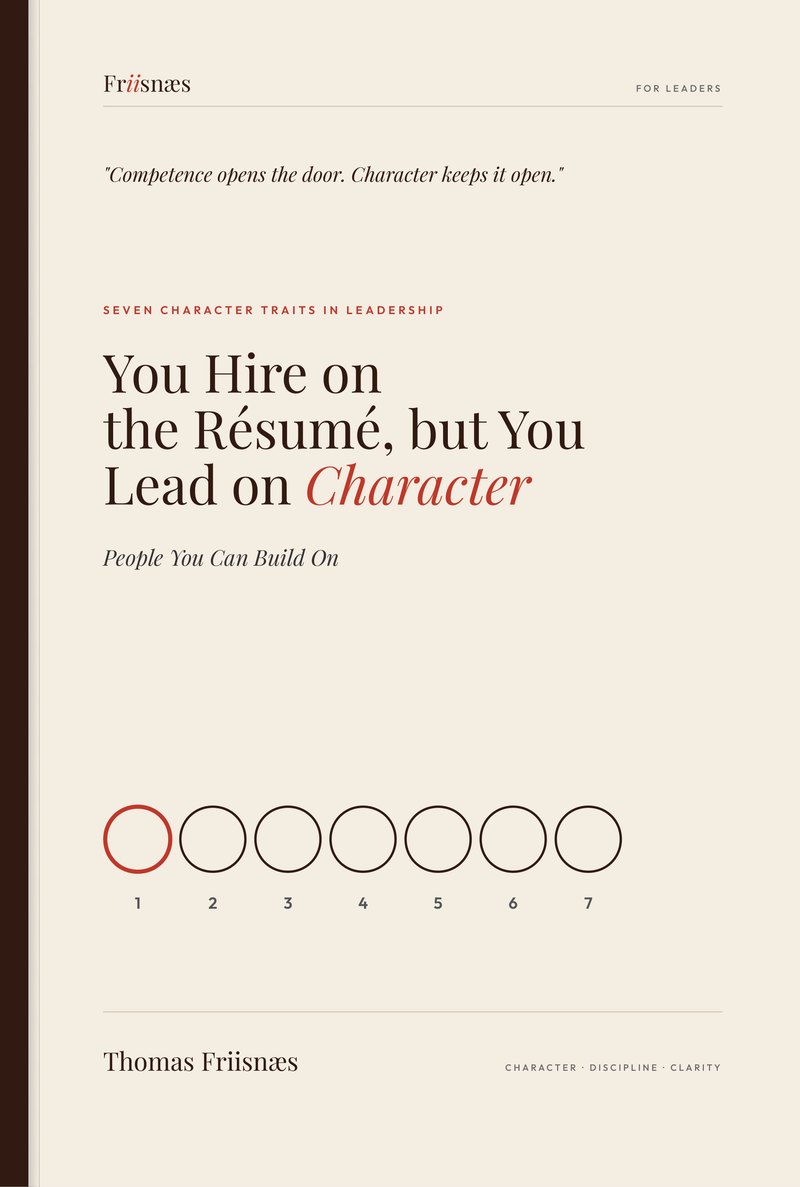
Seven character traits in leadership
You Hire on the Résumé, but You Lead on Character
People You Can Build On
Expertise is expected. Character is the difference. Résumés are starting to look alike. Everyone can list results, everyone can talk strategy, and today a machine can help them do both. What you can't read on paper is the only thing that decides whether people will follow you.
Buy on Amazon.com Read a sample
Kindle e-book and paperback (6 × 9 in, 150 pages, ISBN 978-87-85647-09-2). Published by Friisnæs, Denmark.
The seven character traits
What the book trains
- 1 Integrity The ability to stand by who you are and do the right thing, even when no one is watching. Do you do the right thing when no one is looking?
- 2 Curiosity The will to ask questions and actually want to know the answer. Do you want to learn, or do you want to be right?
- 3 Work Ethic The ability to keep going when the work is boring, hard, or invisible. Do you keep showing up, even when it isn't fun?
- 4 Independence with Judgment The ability to act on your own, but with care. Do you take initiative with good judgment?
- 5 Social Intelligence The ability to read the room, adapt, and contribute constructively with others. Do other people get better by working with you?
- 6 Professional Humility The ability to know you don't know everything, and still be competent. Do you know enough to know you don't know everything?
- 7 Willingness to Take Risks The ability to act even when you have no guarantees. Do you dare to do something that might fail?
This book is for you if you lead people, develop leaders, or sit at the head of the table yourself. It gives you a concrete language and a concrete method to assess character, not just competence; to promote the right people and pass on the wrong ones in time; and to create a leadership layer you can actually build on when things move fast.
Three parts, 15 chapters, 45 models. Part I makes the case for character as the foundation of leadership. Part II takes the seven traits one at a time, each with a Trait Card: what it looks like in practice, how to spot it in the conversation, how to train it every day, and what happens when it breaks. Part III is about character as culture: how to spot it before you hire or promote, how to develop it in your team, what to do when it wavers, and when your own character is tested. Every chapter ends with three questions for you and your team, and from chapter 3 also with a sparring prompt for your own AI assistant.
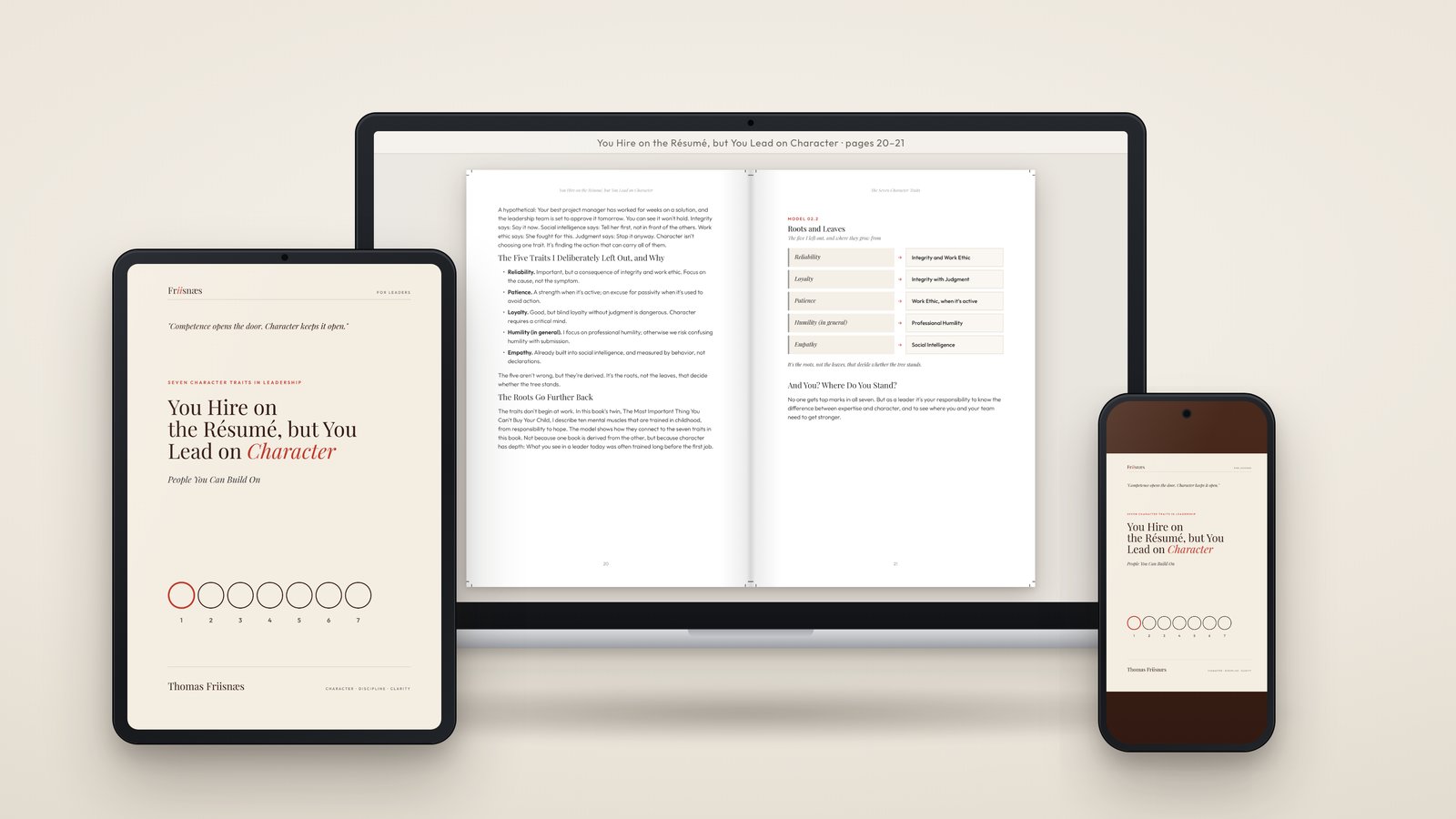
The book's tools
Use it while it's happening
The book points here. Everything below is free, works in your browser or on paper, and nothing you type leaves your own device.
The Character Check · Two Minutes
Seven statements, two minutes, no total score. Think about the past 30 days and mark how often each statement fits you. It isn't a psychological test. It's a mirror. Use it on yourself, never as a score for someone else. Your answers are yours alone; nothing is sent anywhere.
Open the Character Check →The reflection sheet
The seven character traits as a reflection sheet (appendix B): a mirror, not a form. For yourself: where am I strong, where do I feel resistance? For the team: what do we see in each other?
Letter (US) PDFA4 PDFThe Character Checklist
When you hire or promote (appendix F): the same questions for every candidate, listening for specific examples. It won't give you the right answers. It helps you ask the right questions.
Letter (US) PDFA4 PDFThe 30-Day Challenge
Character in daily practice (appendix G): 30 simple actions, five days per trait, that you can start on today. They don't take much time, but they do require that you mean it.
Letter (US) PDFA4 PDFAbout the author
Thomas Friisnæs
Thomas Friisnæs (b. 1966) is an executive coach, author, and observer of human character. His philosophy is simple: you don't lead on titles, you lead on trust. And trust is built on character. For more than 22 years he has sat across from senior executives, owner-managers, and CEOs, with more than 15,000 conversations behind him. The book is translated from the Danish original Du ansætter på CV – men du leder på karakter (2026).

Also in English
The Most Important Thing You Can't Buy Your Child
The twin of this book, written for parents and grandparents. Ten mental muscles, four ages, and three generations: a character training program with ten concrete tools for each muscle and one small experiment per chapter. The traits in this book don't begin at work; the twin shows where they are trained first.